Again in March, we reviewed AMD's newest Zen Three based mostly EPYC 7003 processors, together with the 64-core EPYC 7763 and 7713. We've up to date the info again in June with a retail motherboard, and it scores a lot greater, exhibiting how EPYC Milan will be refined greater than it was at launch. Placing two 64-core processors right into a system requires a greater than succesful motherboard, and in the present day on the check bench is the GIGABYTE MZ720-HB0 (Revision 3.0), which has loads of options to boast about. A number of the most vital ones embrace 5 full-length PCIe 4.Zero slots, twin 10 GbE, numerous PCIe 4.Zero NVMe and SATA storage choices, in addition to twin SP3 sockets, and sixteen reminiscence slots with help for as much as Four TB of capability.
GIGABYTE MZ72-HB0 Overview
Though the GIGABYTE MZ72-HB0 motherboard for AMD's EPYC processors basically is not new, we reported again throughout Computex 2021 that GIGABYTE launched a brand new revision (Rev 3.0) of this mannequin to help each Milan (7003) and Rome (7002) out of the field, because the preliminary Revision 1.Zero mannequin solely included help for Naples (7001) and Rome (7002). This is because of a small maneuvering of AMD's product stack - the most recent 64 core processors now push a TDP of 280 W per processor, relatively than 240 W, and whereas the socket is similar throughout all three generations, you can see that motherboards both help 7001+7002, or 7002+7003 relying on once they had been designed. So if you'd like the MZ72-HB0 to help Milan 7003 processors, you want revision 3.0, which we've in the present day.
As with many server-focused motherboards, even in additional 'normal' type components, the GIGABYTE MZ72-HB0 focuses primarily on performance and substance over fashion. GIGABYTE has opted for its typical blue-colored PCB, with the identical theme stretching to the sixteen reminiscence slots on the board. Taking a look at reminiscence help, the MZ72-HB0 helps as much as 2 TB per socket, in eight-channel reminiscence mode, specializing in reminiscence as much as DDR4-3200 RDIMM, LRDIMM, and 3DS varieties all supported. As this can be a dual-socket EPYC motherboard, there are two SP3 sockets with 4 horizontally mounted reminiscence slots on both facet, and every socket can home processors as much as 280 W TDP.
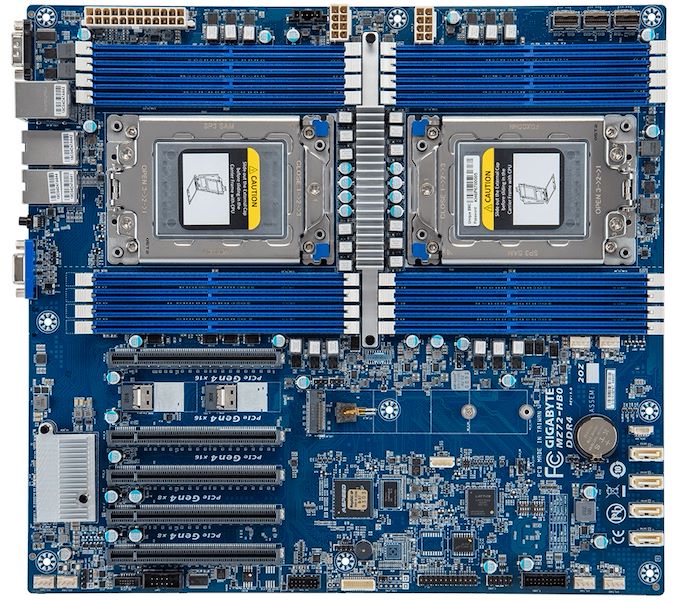
Taking a look at connectivity, the MZ72-HB0 has 5 full-length PCIe 4.Zero slots, with three of them supporting the total PCIe 4.Zero x16 bandwidth, whereas the others are x8 however nonetheless full size. With the intention to stability the load on every CPU, three of the slots are managed by the left CPU trying on the structure above, with the opposite two being managed from the precise CPU. Extra element on that is on the next web page the place we analyze the topology of the motherboard.
On the rear panel is a fundamental choice of inputs, with two USB 3.Zero Kind-A ports, in addition to a D-Sub and Gigabit Administration LAN port which permit entry to the BMC, which is managed by a generally used ASPEED AST2600 controller. Networking connectivity consists of two 10 GbE ports, whereas storage choices are aplenty. These choices embrace one bodily PCIe 4.Zero x4 M.2 slot, with two NVMe SlimSAS 4i ports, and three SlimSAS ports able to supporting as much as twelve SATA ports, or three PCIe 4.Zero x4 NVMe based mostly drives. For typical SATA storage, the GIGABYTE has 4 SATA slots.
Referring to the efficiency, it is no shock that the MZ72-HB0 takes a very long time in addition into Home windows - it took us simply over two and a half minutes from powering the system onto loading into the OS. It takes this lengthy from a chilly boot as a system takes time to initialize the networking controller, the BMC, and different important components to make itself prepared for POST. When it comes to energy, we measured a peak energy draw at full load with twin 280 W processors of 782 W. In our DPC latency testing, the GIGABYTE did not rating that properly, however that's normally par for the course with server motherboards with BMC interfaces.
For our up-to-date CPU efficiency numbers with this board, we examined quite a few dual-socket EPYC 7003 configurations on this board, please try the hyperlink under:
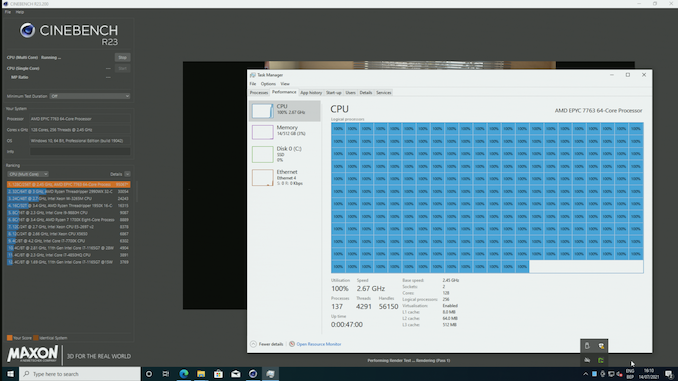
Two AMD EPYC 7763 processors working Cinebench R23 - 256 threads anybody?
On this explicit market house, there's loads of devoted 1U server choices able to supporting one or two EPYC 7003 processors, in addition to the customized market. ASUS, ASRock Rack, GIGABYTE Server and others have choices to swimsuit all manners of configurations, however there are few dual-socket choices in additional normal type components just like the E-ATX GIGABYTE MZ72-HB0. That makes the MZ72-HB0 fascinating, because it's clear GIGABYTE Server has risen to the problem of becoming two giant SP3 sockets and 5 full-length PCIe 4.Zero slots, together with all the opposite controllers and connectivity to profit from EPYC's giant PCIe lane depend. There are limitations as a result of smaller E-ATX type issue together with 16 versus 32 reminiscence slots, and different PCIe slots to profit from the total 128 lanes (solely 88 are used on this system), however let's get into the assessment and see how the GIGABYTE MZ72-HB0 Rev 3.Zero handles our benchmark suite.
Learn on for our prolonged evaluation.
Posting Komentar
Posting Komentar