Benchmarks and efficiency measurements are a main-stay of analysis of gadgets and integral elements of the evaluation course of for lots of people – together with each precise customers in addition to publications or analysts as ourselves. Previously, when this relationship between benchmarks and real-world apps was damaged, we’ve all the time tried to reveal such behaviour with a view to have the distributors right their methods, which result in fairly a couple of articles over time:
From time to time, these matters all the time resurface as distributors try and “differentiate” their gadgets amongst the group – it’s a repeated course of which sadly by now now not actually surprises us when it occurs.
At the moment’s piece matches inside this class of articles, and extra particularly covers OnePlus’ latest OnePlus 9 Professional flagship telephone, and the way its efficiency behaviour certainly manages to be extraordinarily distinctive within the present cellular panorama. It’s one thing so uncommon and baffling, because it really blurs the road between battery optimisation, efficiency dishonest, and common system specification misrepresentation.
We now have detected that OnePlus is blacklisting fashionable purposes away from the its quickest cores, inflicting decelerate in typical workloads comparable to internet looking. We now have confirmed that (a) benchmarks or (b) unknown apps get full efficiency; many of the high fashionable non-benchmark apps get notably diminished efficiency. That is maybe to enhance battery life on the expense of efficiency, nevertheless it does imply that the common benchmark outcomes are considerably ineffective for person expertise.
Beginning off with bizarre benchmark numbers
As all the time with these tales, all of it begins out when discovering some bizarre oddity when going over the standard evaluation course of. The OnePlus 9 Professional was launched in early April, nonetheless as a consequence of different work within the pipeline we by no means received to completely evaluation the telephone till now – effectively, that’s additionally a bit delayed as a consequence of in the present day’s piece.
In testing, I had encountered one thing which actually perplexed me, and caught my attention; seemingly inexplicable sluggish browser benchmark figures which weren't consistent with another Snapdragon 888 system out there, getting solely a fraction of the scores and efficiency of different gadgets.
[embed]https://www.youtube.com/watch?v=EoY2a8RzJck[/embed] [embed]https://www.youtube.com/watch?v=qy3AQx-eqjc[/embed]
OnePlus 9 Professional - Chrome & Vivaldi Efficiency
Particularly, Chrome appeared to be affected by extraordinarily bizarre behaviour that at worst ended up with the browser solely having the ability to use the SoC’s little Cortex-A55 cores.
Within the first/left video – I’m beginning Chrome contemporary and operating the browser-based Speedometer 2.Zero benchmark. In the course of the first run, the telephone is managing a rating of 61.5 – a low rating that’s very irregular for a Snapdragon 888. Monitoring the CPU’s behaviour throughout the run factors out that the system is rarely loading the Cortex-X1 core of the Snapdragon 888, and as an alternative is operating the benchmark on the Cortex-A78 cores. Moreover, these are operating at solely 2GHz as an alternative of their most 2.41GHz. What’s extra perplexing, is that when re-running the check instantly once more in sequence, the workload is now being fully remoted to the little Cortex-A55 cores, with an expectedly horrible rating of 16.8.
We’ll get into extra element a bit later about browsers – however the one approach I ever managed to attain the complete efficiency of the Snapdragon 888 and have the X1 cores being loaded within the benchmark was in Vivaldi, ensuing with a rating of 107 which is consistent with different Snapdragon 888 telephones. What’s totally perplexing nonetheless, is that whereas this rating was repeatable back-to-back, it was solely ever achievable on a contemporary set up of the browser. Closing the app and re-launching it induced it to once more now not work on the Cortex-X1 cores, and solely run on the Cortex-A78 cores – this time round on the full 2.41GHz.
In another WebView container built-in in any app, I used to be by no means capable of get any internet content material to work on the X1 cores, or if it labored, it acted like Vivaldi in that it labored as soon as after which by no means once more.
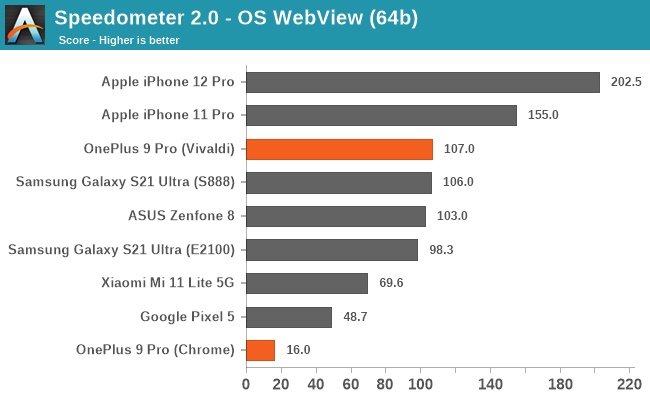
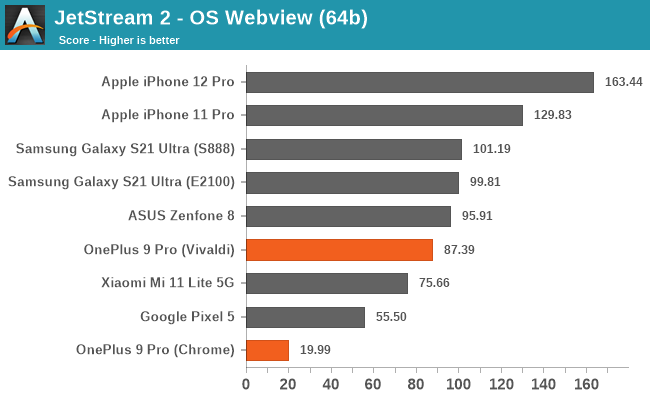
This resulted into some actually oddball benchmark numbers that painting the OnePlus 9 Professional as a early-2010’s price range system, with horrible efficiency.
The factor is, is that these figures didn't fall consistent with another benchmark scores of the system. All our in-house benchmarks in addition to third-party benchmarks offered regular efficiency figures with what you’d count on from a Snapdragon 888 telephone, exhibiting nothing notably completely different.
Diving deeper: Traces of detection, OnePlus' kernel code
Naturally this perplexing behaviour piqued my curiosity as I used to be making an attempt to determine what’s taking place and what’s going unsuitable. Investigating the system’s OS logs, I managed to detect a repeatable behaviour between purposes that behaved extraordinarily weirdly, and those who didn’t.
Particularly, there are entries with regard to some form of OnePlus Efficiency service that's operating on the telephone that's dealing with High quality of Service requests. Typically, these sorts of mechanisms aren’t notably attention-grabbing as many distributors do have OS framework aspect mechanisms to permit for higher efficiency experiences comparable to for instance when launching or switching between apps. What was bizarre about OnePlus right here is that it didn’t deal with all apps equally:
I/OPPerf: perfAcquire # perflock change #: SPerfInfo{web.oneplus.launcher 160 cpu_bouncing_01 0}
I/OPPerf: perfAcquire # SCHEDTUNE change # : SPerfInfo{web.oneplus.launcher 160 cpu_bouncing_01 0}
I/OPPerf: mayPerfRelease # : SPerfInfo{web.oneplus.launcher 160 cpu_bouncing_01 0}
I/OPPerf: mayPerfRelease # reset SCHEDTUNE # : SPerfInfo{web.oneplus.launcher 160 cpu_bouncing_01 0}
I/OPPerf: perfAcquire # SPerfInfo{com.android.chrome 160 cpu_bouncing_02 0}
I/OPPerf: perfAcquire # set SCHEDTUNE #: SPerfInfo{com.android.chrome 160 cpu_bouncing_02 0}
On this log snippet, we see that the service acquires some schedtune efficiency lock (basically some QoS degree) when getting into the default launcher, and when switching away from it, it releases this lock. When switching to Chrome, it additionally acquires an absence with some parameter known as “cpu_bouncing_02” – a bit extra particulars in a while this.
I/OPPerf: perfAcquire # SPerfInfo{web.oneplus.launcher 160 cpu_bouncing_01 0}
I/OPPerf: perfAcquire # set SCHEDTUNE #: SPerfInfo{web.oneplus.launcher 160 cpu_bouncing_01 0}
I/OPPerf: mayPerfRelease # : SPerfInfo{web.oneplus.launcher 160 cpu_bouncing_01 0}
I/OPPerf: mayPerfRelease # reset SCHEDTUNE # : SPerfInfo{web.oneplus.launcher 160 cpu_bouncing_01 0}The odd factor is, that when switching to a third-party browser comparable to Vivaldi, the lock doesn’t seem, and the efficiency service by no means truly does something when switching away from the launcher.
I used to be curious what cpu_bouncing is meant to be and certain sufficient, there’s a OnePlus module inside the firm’s kernel modifications which seems to be associated to customized CPU frequency governor insurance policies and configurations.
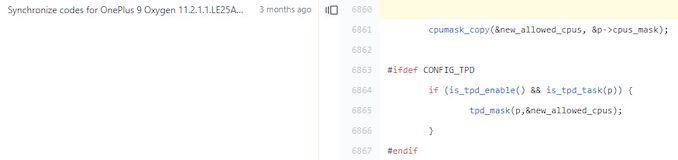
Past that, it additionally appears that OnePlus had made some scheduler modifications including what it calls TPD or thread placement determination mechanism that enables for customised CPU affinity masks, limiting thread and activity placements primarily based on a classification that goes past the standard generic system CPU affinity, and even Android default framework app cpusets. This seemingly to me appears to be what's the mechanism that's limiting workloads from being positioned on the Cortex-X1 cores – and even the A78 cores in some locations.
A blacklist as an alternative of a whitelist – Spoofing fashionable apps
Thus far, what we discovered is that it appears OnePlus’ OS is detecting the presently run app, and imposing completely different CPU DVFS and scheduler behaviours depending on what you’re operating. Due to the sooner talked about noticed behaviour within the OS logs when switching to Chrome or different apps (I’m utilizing the official Twitter app right here for instance), a method to verify the efficiency discrepancy is trying to easily spoof a customized app to determine itself as a kind of detected apps, which I did with our customized toolset app:
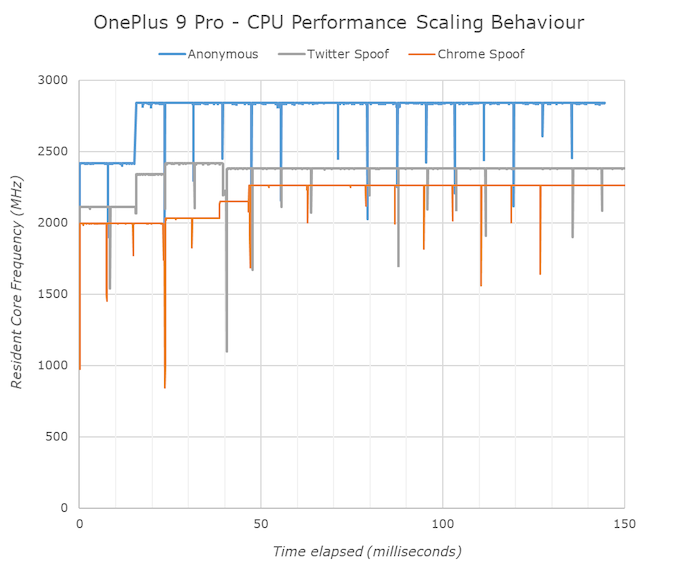
In our customized CPU frequency scaling monitoring check, which works on absolute timescales in microsecond granularities, we instantly see that there’s a big distinction between operating the check as a nondescript workload, and operating it spoofed because the Chrome or Twitter apps. Because the nameless check, the CPU behaviour usually consistent with what we’d see in Qualcomm system, although fairly a bit extra aggressive as a consequence of OnePlus utilizing an 8ms load monitoring window. The CPU rapidly reaches the X1 cores at 2.84GHz as one would count on.
The Chrome and Twitter spoofed variants of the identical check behave very completely different and the scaling is way slower, reaching most efficiency states 3-4x slower. That’s usually nonetheless superb, however what’s actually regarding right here is once more that the workloads by no means truly attain the X1 cores, or solely at very diminished frequencies far beloew the two.84GHz state.
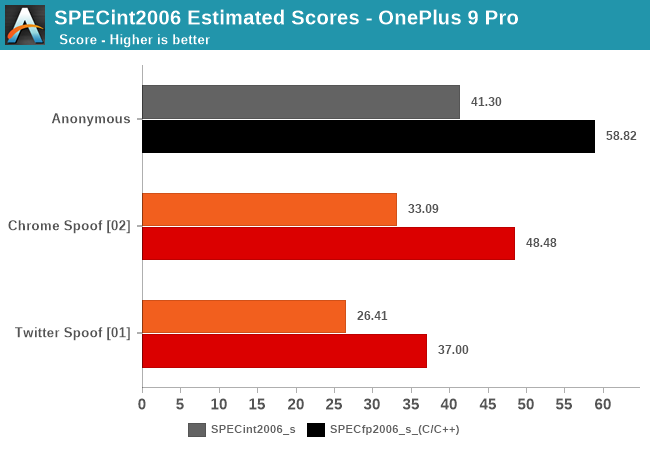
We’ve confirmed that the scaling is completely different, however what’s precisely the ensuing efficiency? Operating the SPEC suite disguised as each Chrome and Twitter, we are able to see some huge variations within the ensuing efficiency, in comparison with operating the workload as a non-detected software.
Within the Chromed spoofed variant, it does seem that the workload is allowed to scale as much as the Cortex-X1 cores of the Snapdragon 888, however these are restricted at 2.26GHz as an alternative of two.84GHz. This 20% discount in frequency comes with a corresponding 20% discount in rating efficiency within the check.
Within the Twitter spoofed variant, the workload by no means reaches the X1 cores and as an alternative falls in at a gentle state of 2GHz on the Cortex-A78 cores. The efficiency right here is correspondingly fairly meagre, showcasing solely 64% that of what the Snapdragon 888 is meant to be obtain. This determine right here additionally falls consistent with the browser benchmark figures earlier once they do get scheduled on the A78 cores.
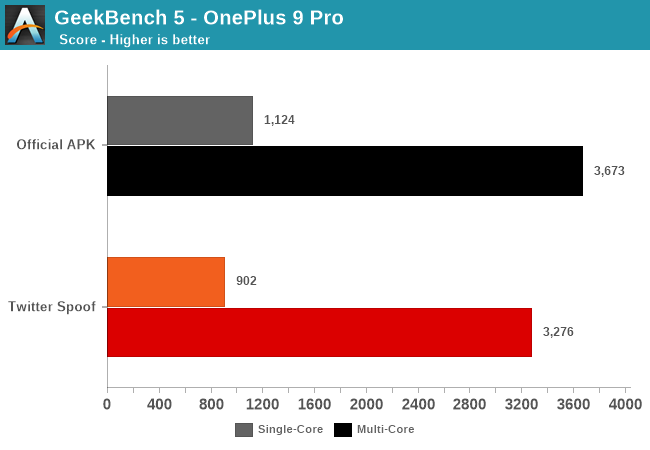
We’ve additionally reached out to Primate Labs’ John Poole to copy the behaviour in a well-liked benchmark comparable to GeekBench. Spoofing GeekBench 5 as both Chrome or Twitter additionally ends in notably decrease benchmark figures which can be 20% beneath of the height efficiency of the Snapdragon 888. The X1 cores right here seem to go to 2380MHz which traces up with the limitation that’s present in OnePlus kernel sources, and the A78 cores additionally by no means transcend 2GHz within the multi-threaded checks.
I’m not too certain why we're seeing a single-threaded behaviour discrepancy between SPEC and GB5 right here, and why my check toolkit degraded far decrease in efficiency, nevertheless it seems to be associated to OnePlus’ extraordinarily convoluted thread placement insurance policies.
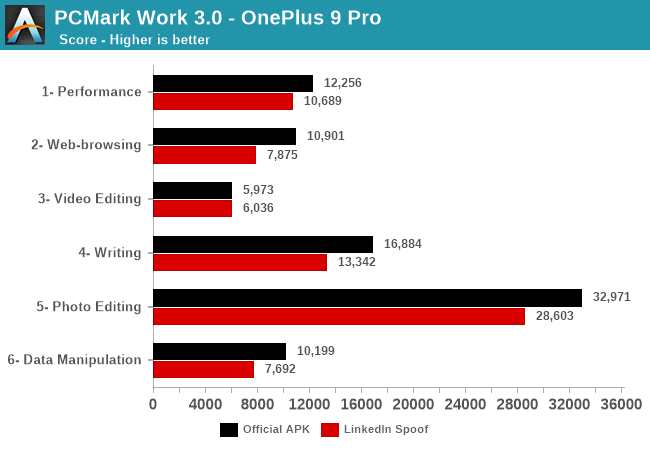
PCMark is meant to be extra of a real-world illustration of system efficiency when it comes to dynamic UI workloads. Additionally right here, when altering the applying ID to one thing like LinkedIn ends in some dramatic efficiency decreases in a few of the checks. The “Writing” sub-test which I think about some of the vital and consultant for total system responsiveness sees an enormous 34% discount in its rating. The Knowledge Manipulation check can be very single-threaded sure, and since the X1 cores are neutered, it additionally sees a big 36% discount.
What apps are affected, and the actual elephant within the room
We primarily talked about Chrome and Twitter till now, however the massive query here's what different purposes are affected and detected by OnePlus’ efficiency limiting mechanism. Whereas I haven’t found the likes of a smoking gun when it comes to the precise blacklist used for software detection – more than likely buried deep into the OS’ frameworks, the subsequent smartest thing could be to easily check out varied fashionable purposes, and to verify whether or not they’re being detected or not:
02
us.zoom.videomeetings
com.whatsapp
com.fb.katana
com.zhiliaoapp.musically (TikTok)
com.instagram.android
com.snapchat.android
com.google.android.youtube
com.chrome.beta
com.android.chrome
01
com.android.settings
web.oneplus.launcher
web.oneplus.boards
web.oneplus.climate
com.oneplus.backuprestore
com.oneplus.filemanager
com.oneplus.word
com.oneplus.gallery
com.oneplus.digicam
com.reddit.frontpage
com.twitter.android
com.amazon.mShop.android.buying
com.android.merchandising
com.dropbox.android
org.mozilla.firefox
com.google.android.dialer
com.google.android.gm
com.google.android.documentsui
com.google.android.apps.docs.editors.docs
com.google.android.apps.pictures
com.google.android.apps.conferences
com.google.android.apps.messaging
com.linkedin.android
com.discord
com.netflix.mediaclient
com.king.candycrushsaga
com.adobe.lrmobile
com.adobe.reader
television.twitch.android.app
com.microsoft.emmx
com.courageous.browser
com.nianticlabs.pokemongo
com.microsoft.groups
com.adobe.scan.android
org.videolan.vlc
com.strava
com.amazon.avod.thirdpartyclient
com.airbnb.android
com.ubercab
com.ubercab.eats
com.microsoft.workplace.outlook
com.microsoft.workplace.excel
com.microsoft.workplace.powerpoint
com.microsoft.workplace.officehubrow
com.microsoft.workplace.phrase
This checklist is certainly not exhaustive, however merely represents the apps which I examined out earlier than deeming it adequate to get the purpose throughout.
What’s evident right here, is that this isn't a mechanism solely making use of to a handful of apps, however applies to just about every little thing that has any degree of recognition within the Play Retailer, together with the entire of Google’s app suite, all of Microsoft’s Workplace apps, all fashionable social media apps, and any fashionable browser comparable to Firefox, Samsung Web, or Microsoft Edge. Vivaldi was one of many browsers which wasn’t detected and subsequently one of many solely I managed to get any cheap efficiency out of.
The one apps which have been notably absent from detection have been a few of the fashionable video games on the market, whereas the likes of Sweet Crush have been efficiency restricted, Genshin Affect was not. After all, on high of video games, no benchmark app was detected. Different purposes which additionally weren't detected have been much less fashionable alternate options – whereas for instance Uber and Uber Eats are detected, Lyft and Grubhub weren't.
Past all fashionable purposes – what additionally actually stands out is that each one of OnePlus’ personal first-party apps are included inside this checklist, even as far as the OS’ system settings, and that is the place issues grow to be problematic.
How will we quantify efficiency in such a situation?
At this level, there’s evidently a big disconnect between the efficiency that’s exhibited in the preferred purposes on the market and the experiences that customers might be having inside the preferred purposes available on the market, and even OnePlus personal apps.
The one open query that continues to be is with regard to how precisely this complete mechanism impacts the subjective person expertise. In any case, the telephone has been out for a couple of months now and basically no one has remarked something in regards to the common efficiency of the telephone. The rationale right here is that whereas efficiency peaks are evidently restricted, it stays a responsive telephone, and there are mechanisms at play which struggle towards the constraints, comparable to OS framework boosters and contact boosters. For instance, whereas you can see internet content material just about restricted to the little Cortex-A55 cores more often than not, this doesn’t apply while you work together with the telephone as momentary contact booster will migrate issues over to the center A78 cores.
I wouldn’t blame anyone in the event that they hadn’t essentially observed the efficiency discrepancy – I hadn’t instantly observed it myself past the gadgets’ extraordinarily sluggish momentum scrolling pace setting. Nevertheless, having it side-by-side to a Samsung Galaxy S21 Extremely, or a Xiaomi Mi11 (Extremely) and paying consideration, I do very a lot discover that the OnePlus 9 Professional is much less responsive.
The issue with claims comparable to “much less responsive” is that we can not quantify it correctly. Whereas there are official reviewers on the market who're happy in writing about subjective efficiency evaluations – our pedigree right here at AnandTech is all about having the ability to justify these claims with goal measurements. On this case, OnePlus is leaving us with very restricted choices.
Optimisation, or misrepresentation of what you’re being offered?
An extra query is why precisely OnePlus has created such a mechanism within the first place? What precisely is the aim the corporate software program groups have been making an attempt to attain? Typically, up to now, software detection mechanisms have been included as makes an attempt to color gadgets in higher gentle with regard to their efficiency. On this case, that is truly nonetheless the case – it’s simply that as an alternative of accelerating the benchmark efficiency, the corporate is decreasing real-world software efficiency to beneath that of the theoretical {hardware} capabilities.
The one smart rationale for such a choice is to enhance a tool’s energy effectivity and battery life. The OnePlus 9 Professional, though it advertises itself as utilizing the most recent LTPO OLED know-how as Samsung’s Galaxy S21 Extremely for instance, nonetheless suffers from notably worse energy traits and worse energy effectivity. In our web-browsing battery life check, even with this efficiency crippling mechanism in place, with each gadgets at 120Hz underneath the identical check situations, the OnePlus 9 Professional achieves 11.75 hours of runtime, versus the S21 Extremely’s 13.98 hours, the latter which runs on the SoC’s full efficiency potential. I’ll be operating the identical check inside an undetected browser comparable to Vivaldi to see what it finally ends up at – however I believe it’ll be notably worse for the OP9Pro.
Whereas software behaviour and efficiency varies case by case, the one side that holds true in virtually all eventualities is that the OnePlus 9 Professional doesn’t ship on the complete traits of the Snapdragon 888. In blacklisted/detected purposes, when and if the X1 cores are getting used in any respect, frequencies past 2.38GHz are unreachable save for temporary booster moments. The overwhelming majority of apps fall again to 2GHz Cortex-A78 cores. That is all a bit ironic as the explanation the bigger extra efficiency X-series cores have been created within the first place was to serve excessive transient response efficiency workloads, one thing they’re not allowed to do right here.
The one argument I've in in decoding this mechanism as a misrepresentation of system efficiency quite than an total energy effectivity optimisation is the actual fact that it doesn’t apply equally to all apps. If you happen to’re utilizing some extra obscure app on the market, you’ll be getting higher efficiency than in comparison with a extra fashionable app. Benchmark purposes are additionally in fact not representing the “meant” efficiency of the system – and I declare right here for it to be the meant efficiency of the system, as that is how OnePlus configures its personal OS and first-party apps. Out of the field, virtually all preinstalled apps behave on this efficiency restricted trend.
The entire scenario is quite baffling, and positively represents the primary case of a vendor implementing software and benchmark detection on this method, with variations in efficiency differing to such a level. I’m not too certain what to make of it, bar merely exposing it and have customers come to their very own conclusion.
Editor’s word: At the moment’s article focuses solely on the OnePlus 9 Professional, examined on firmware 11.2.6.6. As a consequence of missing sibling or previous gadgets, we weren't capable of verify whether or not this mechanism is current on different OnePlus telephones.
Replace: OnePlus has printed a press release to the colleagues at XDA:
“Our high precedence is all the time delivering an incredible person expertise with our merchandise, primarily based partly on appearing rapidly on vital person suggestions. Following the launch of the OnePlus 9 and 9 Professional in March, some customers advised us about some areas the place we may enhance the gadgets’ battery life and warmth administration. Because of this suggestions, our R&D workforce has been working over the previous few months to optimize the gadgets’ efficiency when utilizing most of the hottest apps, together with Chrome, by matching the app’s processor necessities with probably the most applicable energy. This has helped to supply a clean expertise whereas decreasing energy consumption. Whereas this may increasingly influence the gadgets’ efficiency in some benchmarking apps, our focus as all the time is to do what we are able to to enhance the efficiency of the system for our customers.”
The reasoning is mostly consistent with what we suspected; aiming at enhancing battery life the system. Nevertheless, OnePlus doesn’t additional clarify why solely particular apps have been focused, and why the mechanism was opaque to customers. Moreover, the assertion appears to learn because it was a post-launch replace change, nonetheless the behaviour could be confirmed to have already existed in day-1 evaluations from different websites comparable to PhoneArena or NoteBookCheck previous to the launch date of the telephone on March 31st.
Posting Komentar
Posting Komentar