In an unique to AnandTech, we spoke with Synopsys’ CEO Aart de Geus forward of a pair of keynote shows at two upcoming technical semiconductor business occasions this 12 months. Synopsys reached out to present us an outline of the important thing subject of the day, of the 12 months: as a part of these talks, Aart will talk about what was thought-about inconceivable just a few years in the past – the trail to discovering a greater and automatic manner into chip design by way of using machine studying options. Inside the context of EDA instruments, as Google has demonstrated just lately, engineers might be assisted in constructing higher processors utilizing machine studying algorithms.
The Fashionable Push-Pull Economics of Higher Knowledge Evaluation Instruments
For those who learn mainstream columns about expertise and progress right now, there's an eminent concentrate on the ideas of massive knowledge, synthetic intelligence, and the worth of analyzing that knowledge. With sufficient knowledge that has been analyzed successfully, firms have proven that they're proactive to clients, predict their wants upfront, or determine traits and react earlier than a human has even seen the information. The extra knowledge you've gotten analyzed, the higher your actions or reactions might be. This has meant that analyzing the quantity of knowledge itself has intrinsic worth, in addition to the pace at which it's processed. This has brought on an explosion of the demand for higher evaluation instruments but in addition an explosion in knowledge creation itself. Many senior figures in expertise and enterprise see the intersection and improvement of machine studying knowledge evaluation instruments to churn by way of that knowledge because the mark of the following technology of economics.
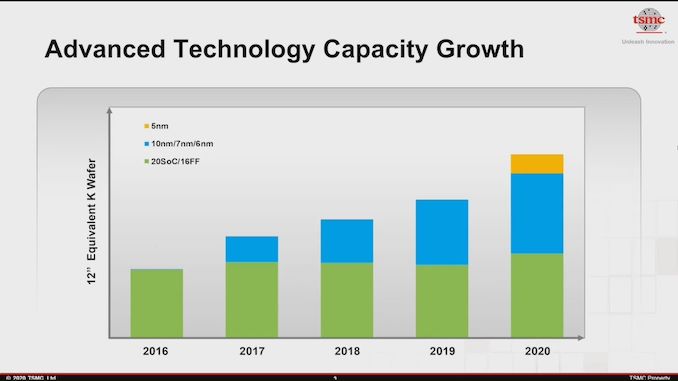
Graph exhibiting manufacturing progress of key silicon product traces since 2016
at TSMC, the world's largest contract producer
The need to have the very best resolution is accelerating the event of higher utilities, however on the identical time, the necessity to deploy it at scale is creating immense demand for assets. All of the whereas, a variety of critics are forecasting that Moore’s Legislation, a 1960s remark across the exponential improvement of advanced computing that has held true for 50 years, is reaching its finish. Others are busy serving to it to remain on observe. As driving efficiency requires innovation on a number of ranges, together with {hardware} and software program, the necessity to optimize each abstraction layer to proceed that exponential progress has turn out to be extra advanced, dearer, and requires a basic financial acquire to these concerned to proceed funding.
One of many methods in driving efficiency on the {hardware} aspect is in designing processors to work quicker and extra effectively. Two processors with the identical basic constructing blocks can have these blocks positioned in many alternative orientations, with some preparations useful for energy, others for efficiency, or maybe for design space, whereas some configurations make no sense by any means. Discovering the very best mixture in gentle of the economics on the time is commonly essential to the competitiveness of the product and the buoyancy of the corporate that depends on the success of that product. The semiconductor business is uncommon in that the majority chip design firms successfully guess the complete firm on the success of the following technology, which makes each technology's design extra vital than the final.
People are Sluggish, Brute Drive is Unattainable, However AI Can Assist
In gentle of the speed of innovation, chip design groups have spent tens of 1000's of hours honing their expertise over a long time. However we're at a stage the place a contemporary advanced processor has billions of transistors and tens of millions of constructing blocks to place collectively in one thing the scale of a toenail. These groups use their experience, instinct, and nous to position these models in the very best configuration, and it will get simulated over the course of 72 hours. The outcomes that come by way of are analyzed, the design goes again to be up to date, and the method repeats. Getting the very best human-designed processor on this vogue can take six months or extra, as a result of the variety of preparations doable is equal to the variety of atoms within the identified universe… risen to the ability of the variety of atoms within the identified universe. With numbers so massive, utilizing computer systems to brute drive the very best configuration is inconceivable. At the very least, it was regarded as.
Work from Google was just lately printed within the scientific journal Nature about how the corporate is already utilizing customized AI instruments to develop higher silicon, which in flip helps develop higher customized AI instruments. Within the analysis paper, the corporate utilized machine studying algorithms to seek out the very best mixture of energy, efficiency, and die space for a variety of check designs.
As a way to scale back the complexity of the issue, Google restricted its scope to sure layers throughout the design. Take, for instance, {an electrical} circuit that's designed so as to add numbers collectively - in Google’s work, somewhat than attempt to discover one of the best ways to construct a circuit like this each time, they took a great adder design as a basic constructing block of the issue, mapped the way it interacts with different completely different basic blocks, after which the AI software program discovered one of the best ways to construct these basic blocks. This cuts down the variety of completely different configurations wanted, however the issue continues to be a tough one to crack, as these blocks will work together with different blocks to various levels based mostly on proximity, connections, and electrical/thermal interactions. The character of the work at all times relies on what stage of abstraction these completely different constructing blocks take, and the way advanced/primary you make them.
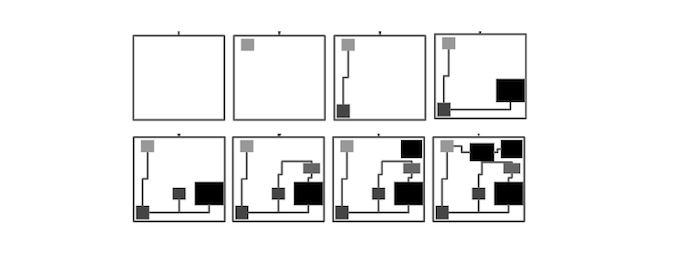
Easy 8-stage instance of block placement and routing impacts the design selections
In Google’s paper, the corporate states that their instruments have already been put to make use of in serving to design 4 components of an upcoming Google TPU processor designed for machine studying acceleration. Whereas the paper showcases that AI instruments weren’t used throughout the entire processor, it's taking among the work that was once painstaking in engineer labor hours and accelerating the method by way of computation. The fantastic thing about this software is that the way in which these constructing blocks might be put collectively can scale, and corporations like Google can use their datacenters to check 1000's of configurations in a single day, somewhat than having a bunch of engineers present a handful of choices after a number of months.
Google’s strategy additionally particulars the impact of utilizing optimized machine studying (so algorithms which have realized find out how to be higher by analyzing earlier designs) towards contemporary machine studying (algorithms with solely a primary understanding that be taught from their very own trial and error). Each these areas are vital, showcasing that in some circumstances, the algorithms don't must be pre-trained however can nonetheless ship a better-than-human consequence. That consequence nonetheless requires extra validation for effectiveness, and the outcomes are fed again into the software program crew to create higher algorithms.
There's Extra To Come, and It Begins with EDA
However that is simply the tip of the iceberg, based on Synopsys CEO Aart de Geus, whose firm's software program helps develop extra silicon processing mental property within the business right now than anybody else. Synopsys has been concerned in silicon design for over 35+ years, with lots of of consumers, and its newest AI-accelerated product is already in use at a variety of high-profile silicon design groups making processors right now to assist speed up time to market with a greater semiconductor placement than people can obtain.

Synopsys is an organization that makes ‘EDA’ instruments, or Digital Design Automation, and each semiconductor firm within the business, each previous and new, depends on some type of EDA to truly deliver silicon to market. EDA instruments enable semiconductor designers to successfully write code that describes what they're making an attempt to make, and that may be simulated to adequate accuracy to inform the designer if it matches inside strict parameters, meets the necessities for the ultimate manufacturing, or if it has thermal issues, or maybe sign integrity doesn't meet required specs for a given commonplace.
EDA instruments additionally depend on abstraction, a long time of algorithm improvement, and because the business is transferring to multi-chip designs and sophisticated packaging applied sciences, the software program groups behind these instruments must be fast to adapt to an ever-changing panorama. Having relied on advanced non-linear algorithm options to help designers so far, the computational necessities of EDA instruments are fairly substantial, and infrequently not scalable. Thus, in the end any important enchancment to EDA software design is a welcome beacon on this market.
For context, the EDA instruments market has two principal opponents, with a mixed market cap of $80B and a mixed annual income of $6.5B. All the foremost foundries work with these two EDA distributors, and it's actively inspired to remain inside these toolchains, somewhat than to spin your individual, to take care of compatibility.
Synopsys CEO Aart de Geus is ready to take the keynote shows at two upcoming technical semiconductor business occasions this 12 months: ISSCC and Scorching Chips. As a part of these talks, Aart will talk about what was thought-about inconceivable just a few years in the past – the trail to discovering a greater and automatic manner into chip design by way of using machine studying options. Inside the context of EDA instruments, as Google has demonstrated publicly, engineers might be assisted in constructing higher processors, or equally not so many engineers are wanted to construct a great processor. Up to now, Aart’s discuss at Scorching Chips will likely be titled:
‘Does Synthetic Intelligence Require Synthetic Architects?’
I spent about an hour talking with Aart on this subject and what it means to the broader business. The dialogue would have made a terrific interview on the subject, though sadly this was simply an off-the-cuff dialogue! However in our dialog, other than the easy incontrovertible fact that machine studying might help silicon design groups optimize extra variations with higher efficiency in a fraction of the time, Aart was clear that the elemental drive and thought of Moore’s Legislation, whatever the actual manner you wish to interpret what Gordon Moore truly stated, continues to be driving the business ahead in very a lot the identical manner that's has been the previous 50 years. The distinction is now that machine studying, as a cultural and industrial revolution, is enabling emergent compute architectures and designs resulting in a brand new wave of complexity, dubbed systemic complexity.
Aart additionally introduced to me the factual manner how the semiconductor business has developed. At every stage of basic enchancment, whether or not that’s manufacturing enchancment by way of course of node lithography resembling EUV or transistor architectures like FinFET or Gate-All-Round, or topical structure innovation for various silicon constructions resembling excessive efficiency compute or radio frequency, we have now been counting on architects and analysis to allow these step-function enhancements. In a brand new period of machine studying assisted design, such because the tip of the iceberg introduced by Google, new ranges of innovation can emerge, albeit with a brand new stage of complexity on high.
Aart described that with each main leap, resembling transferring from 200mm to 300mm wafers, or planar to FinFET transistors, or from DUV to EUV, all of it depends on economics – nobody firm could make the bounce with out the remainder of the business coming alongside and scaling prices. Aart sees using machine studying in chip design, to be used at a number of abstraction layers, will turn out to be a de-facto profit that firms will use on account of the present financial state of affairs – the necessity to have probably the most optimized silicon structure for the use case required. Having the ability to produce 100 completely different configurations in a single day, somewhat than as soon as each few days, is predicted to revolutionize how pc chips are made on this decade.

The period of AI accelerated chip design goes to be thrilling. Onerous work, however very thrilling.
From Synopsys’ perspective, the objective of introducing Aart to me and being able to take heed to his view and ask questions was to present me a taste forward of his Scorching Chips discuss in August. Synopsys has some very thrilling graphs to point out, one in every of which they've offered to me upfront beneath, on how its personal DSO.ai software program is tackling these rising design complexities. The ideas apply to all areas of EDA instruments, however this being a enterprise, Synopsys clearly needs to point out how a lot progress it has made on this space and what advantages it may well deliver to the broader business.
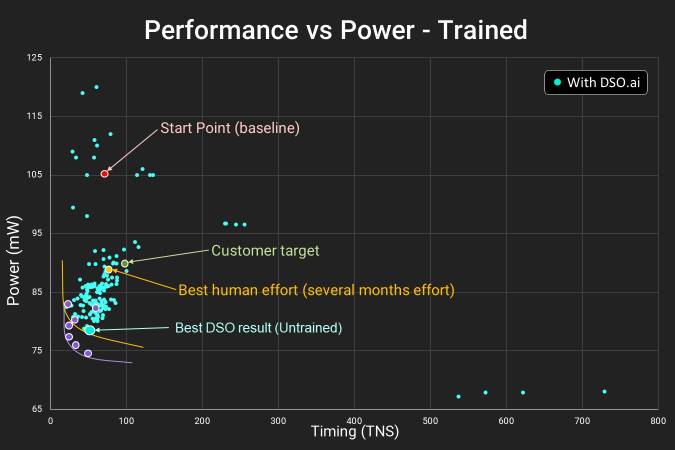
On this graph, we're plotting energy towards wire delay. One of the simplest ways to take a look at this graph is to begin on the labeled level on the high, which says Begin Level.
- Begin Level, the place a primary fast structure is achieved
- Buyer Goal, what the client can be pleased with
- Finest Human Effort, the place people get to after a number of months
- Finest DSO consequence (untrained), the place AI can get to in simply 24 hours
All the small blue factors point out one full AI sweep of inserting the blocks within the design. Over 24 hours, the assets on this check showcase over 100 completely different outcomes, with the machine studying algorithm understanding what goes the place with every iteration. The top result's one thing effectively past what the client requires, giving them a greater product.
There's a fifth level right here that is not labeled, and that's the purple dots that symbolize even higher outcomes. This comes from the DSO algorithm on a pre-trained community particularly for this goal. The profit right here is that in the correct circumstances, even a greater consequence might be achieved. However even then, an untrained community can get nearly to that time as effectively, indicated by the very best untrained DSO consequence.
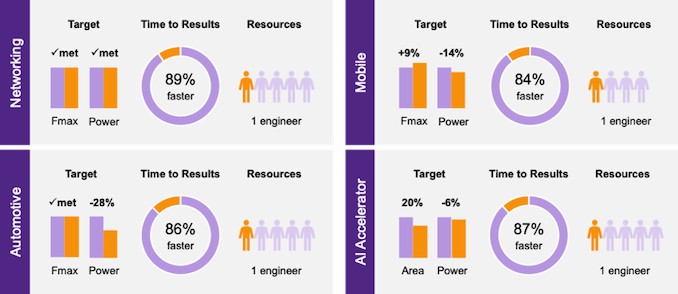
Synopsys has already made some disclosures with clients, resembling Samsung. Throughout 4 design initiatives, time to design optimization was decreased by 86%, from a month do days, utilizing as much as 80% fewer assets and infrequently beating human-led design targets.
I did come away with a number of extra questions that I hope Aart will handle when the time comes.
Firstly I wish to handle the place the roadmaps lie in bettering machine studying in chip design. It's one factor to make the algorithm that finds a probably good consequence after which to scale it and produce 100s or 1000s of various configurations in a single day, however is there a man-made most of what might be thought-about ‘finest’, restricted maybe by the character of the algorithm getting used?
Second, Aart and I mentioned Google’s competitors with Go Grasp and 18-time world champion Lee Sedol, during which Google beat the world’s finest Go participant 4-1 in a board sport that was thought-about inconceivable solely 5 years prior for computer systems to return near the very best people. In that competitors, each the Google DeepMind AI and the human participant made a ‘1-in-10000’ transfer, which is uncommon in a person sport, however one may argue is extra more likely to happen in human interactions. My query to Aart is whether or not machine studying for chip design will ever expertise these 1-in-10000 moments, or somewhat in additional technical phrases, would the software program nonetheless be capable of discover a finest world minimal if it will get caught in an area minimal over such a big (1 in 102500 combos for chip design vs 1 in 10230 in Go) search house.
Third, and maybe extra importantly, is how making use of machine studying at completely different ranges of the design can violate these layers. Most fashionable processor design depends on particular ‘commonplace cells’ and pre-defined blocks – there will likely be conditions the place modified variations of these blocks is perhaps higher in some design eventualities when coupled near completely different components of the design. With all of those parts interacting with one another and having variable interplay results, the complexity is in managing these interactions throughout the machine studying algorithms in a time-efficient manner, however how these tradeoffs are made continues to be some extent to show.
In my current interview with Jim Keller, I requested him if at one level we'll see silicon design look unfathomable to even the very best engineers – he stated ‘Yeah, and it’s coming fairly quick’. It's one factor to speak holistically about what AI can deliver to the world, but it surely’s one other to have it working in motion to enhance semiconductor design and offering a basic profit on the base stage of all silicon. I’m wanting ahead to additional disclosures on AI-accelerated silicon design from Synopsys, its opponents, and hopefully some insights from these which might be utilizing it to design their processors.
Posting Komentar
Posting Komentar