Intel kick-started a form-factor revolution within the early 2010s with the introduction of the ultra-compact NUCs. The methods had been meant to be a substitute for the tower desktops utilized in many functions the place the scale, form, and the system capabilities had been principally unwarranted. The success of the NUCs enabled Intel to begin reimagining the construct of methods utilized in a wider vary of settings.
Extra just lately, the introduction of the Cranium Canyon NUC in 2016 was Intel's first effort to make a gaming-focused SFF PC. And desktop-focused Compute Components (primarily, a motherboard in a PCIe card form-factor) launched in early 2020 meant that full-blown gaming desktops may credibly come below the NUC banner. Additionally final yr, the Ghost Canyon NUC9 – the primary NUC Excessive – made a splash available in the market with assist for a user-replaceable discrete GPU. Ghost Canyon was extraordinarily spectacular, however the restrictions on the dGPU measurement and high-end pricing had been dampeners.
Fortunately, the introduction of Tiger Lake has enabled Intel to make a number of updates in its Compute Aspect lineup. Incorporating some tweaks and modifications discovered from their Ghost Canyon expertise, Intel has now put ahead its flagship NUC for 2021: Beast Canyon. With a desktop-class CPU and talent to accommodate most discrete GPUs available in the market, the Beast Canyon NUC guarantees rather a lot. Does it handle to exorcise the ghosts of its predecessor? Our evaluate beneath supplies some solutions.
Introduction and Product Impressions
Intel's lineup of gaming-focused NUCs began with the Efficiency sequence (Cranium Canyon NUC6i7KYK and Hades Canyon NUC8i7HVK), earlier than shifting up the ladder to the Excessive sequence (Ghost Canyon NUC9i9QNX). The Beast Canyon, introduced on the 2021 Computex, is taking on the flagship mantle this yr. The essential updates over the Ghost Canyon NUC embrace:
- Assist for 65W desktop-class CPUs within the Compute Aspect (in comparison with the 45W cell workstation-focused CPU within the Ghost Canyon's Compute Components)
- Elevated chassis dimensions to accommodate bigger discrete GPUs
- 10nm Tiger Lake CPU with new micro-architectural enhancements for efficiency and power-efficiency
- Assist for a richer set of I/Os (together with PCIe Gen 4)
Intel equipped us with an engineering pattern of the high-end SKU within the Beast Canyon line - the NUC11BTMi9 sporting the NUC11 Excessive Compute Aspect (NUC11DBBi9). This Compute Aspect is housed in a 357mm x 189mm x 120mm chassis. Historically, NUCs have been related to the ultra-compact form-factor (100mm x 100mm in a 0.63L or 0.42L chassis). The introduction of the Cranium Canyon and subsequent Hades Canyon NUCs created yet one more class of 0.7L to 1.2L NUCs, and final yr's Ghost Canyon took it as much as roughly 5L. The necessity to accommodate the cooling resolution of a extra highly effective Compute Aspect, together with the flexibility to simply accept massive dGPUs contribute to the 8L quantity of the Beast Canyon NUC chassis. That is nonetheless inside the realm of SFF PCs - an grownup can nonetheless single-handedly carry the unit round. Different essential SFF features such because the in-built PSU are carried over from the Ghost Canyon NUC.
Intel's NUC lineup has historically included board and equipment variants, permitting its companions to supply worth additions (equivalent to a passive chassis or further I/O ports in the long run system). Kits (aside from those that include a pre-installed OS) require the end-user so as to add storage, DRAM, and set up an OS to finish the system. Intel plans to promote two sorts of the Beast Canyon NUC - the NUC11BTMi9 and the NUC11BTMi7. These two NUCs are kits primarily based on the Driver Bay line of Compute Components. OEMs and end-users can construct their very own NUC11 system primarily based on the next parts:
- Compute Aspect (NUC11DBBi9 or NUC11DBBi7)
- Baseboard (or backplane)
- Chassis
- PSU
- DRAM (as much as 2x DDR4-3200 SODIMMs)
- Non-volatile storage
- Discrete GPU (non-obligatory)
An off-the-shelf Beast Canyon NUC11BTM equipment leaves solely the DRAM, non-volatile storage, and discrete GPU to the selection of the end-user. Previous to the platform evaluation and overview of our evaluate configuration, let's check out the pre-decided parts within the above record.
Driver Bay Compute Aspect
The NUC11BTMi9 we're reviewing as we speak comes with the NUC11DBBi9 NUC11 Excessive Compute Aspect. It comes with a soldered processor - the Core i9-11900KB. This belongs to the Tiger Lake (11th Technology) household, and has a 8C/16T configuration with a 65W TDP. It may turbo as much as 5 GHz. This Compute Aspect is a pure successor to the NUC9 Compute Aspect which re-imagined the normal motherboard in a discrete PCIe x16 card form-factor.
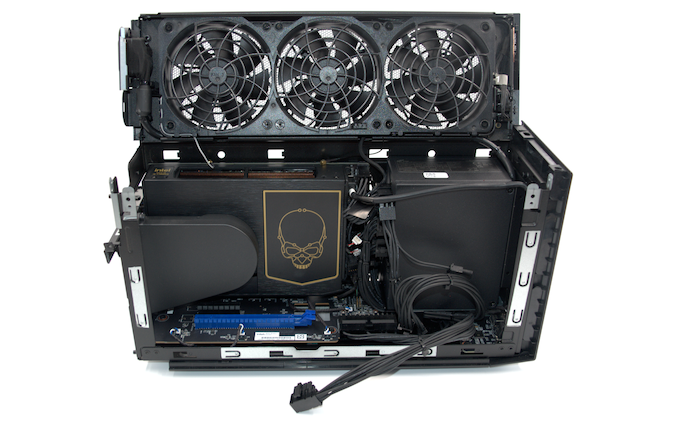
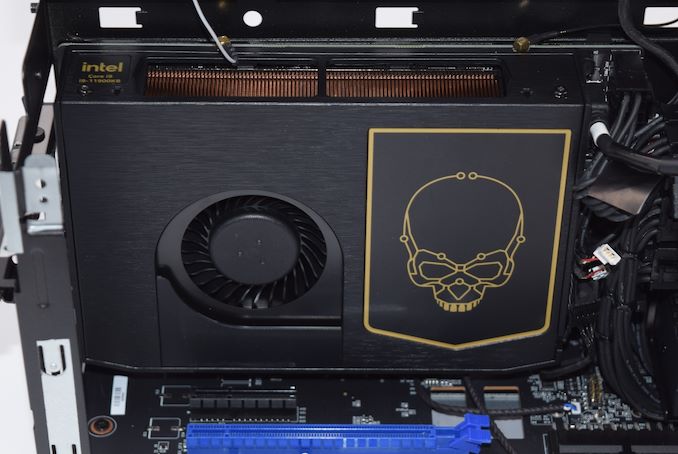
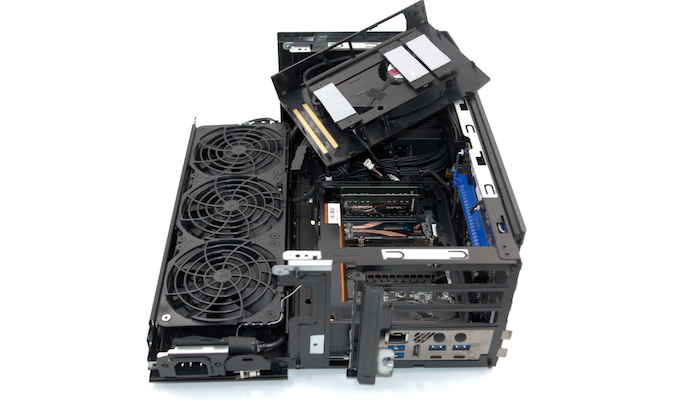
The Compute Aspect comes with a cooling shroud containing a single fan and three M.2 heat-sinks with thermal pads pre-attached. These align with the three M.2 2280 slots within the Compute Aspect. The slot to the precise of the processor is enabled by the x4 Gen Four lanes instantly from the processor, whereas the 2 to the precise (and the M.2 slot occupied by the WLAN card) are from the PCH. On the intense proper, we've got the 2 SODIMM slots that may function at speeds of as much as DDR-3200 for DIMMs as much as 64GB in complete. These are vertical slots (in comparison with the horizontal ones within the NUC9 Compute Components), and release worthwhile area that will get taken up by the additional M.2 slot. The gallery beneath supplies further pictures of the Compute Aspect and the cooling shroud.
The NUC11BTMi9 comes with two Thunderbolt Four ports, a 2.5G Ethernet port, a HDMI 2.0a show output, and 6 USB 3.1 Gen 2 Sort-A ports within the rear. There are two USB 3.1 Gen 2 Sort-A ports, a 3.5mm stereo headset jack, and a SDXC slot with UHS-II assist within the entrance. The entrance I/Os are enabled by a daughterboard that connects to the headers within the Compute Aspect. The Compute Aspect has its personal energy connection to the PSU.
Monster Cove Baseboard
The baseboard used within the Beast Canyon (code identify Monster Cove) is an evolutionary replace to the West Cove board used within the Ghost Canyon. The PCIe lanes are actually Gen 4, however they keep the x8 / x4 / x4 bifurcation capabilities designed into the earlier technology. Fortunately, the M.2 22110 slot ensuing from this bifurcation is now simply accessible from the underside of the chassis, with out having to take out the Compute Aspect from the baseboard.
Just like the West Cove board, the utilization of both of the 2 x4 slots hard-limits the peripheral within the x16 slot to x8 bandwidth. This was a difficulty in our evaluate configuration of the Ghost Canyon NUC, however the Beast Canyon has no such points, as mentioned additional beneath. One of many downsides of the brand new baseboard in comparison with the West Cove is the location of the vertical x4 PCIe slot between the Compute Aspect slot and the x16 slot. As a result of placement of the air information above the Compute Aspect's fan (important because of the 65W TDP of the resident CPU), the x4 slot is rendered unusable.
Chassis and PSU
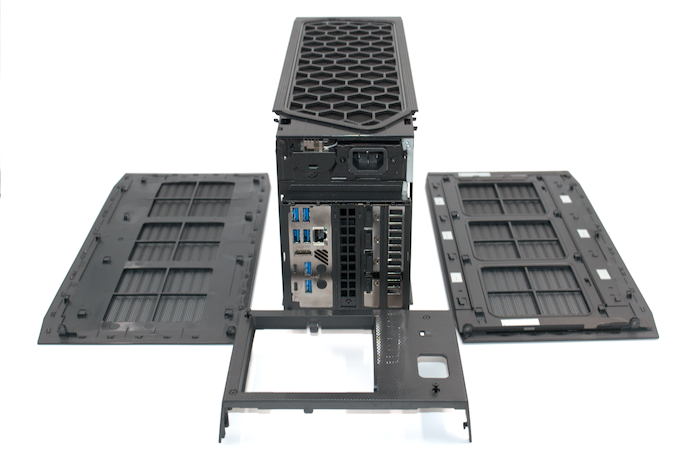
The NUC11BTMi9 chassis has the identical ease of set up because the earlier technology Excessive NUC. The size have been expanded to permit the set up of twin slot GPUs as much as 12" in size. The included 650W 80+ Gold inner PSU additionally provides a 8-pin and a 2x6+2-pin connector for the GPU. The chassis might be disassembled by eradicating the 4 screws to dislodge the rear cowl, and coming out the aspect panels.
The highest panel with the three followers rests on a hinge. The embossed instructions within the body helpfully information the person to open it up. That is important to get entry to the Compute Aspect and take away its shroud to put in the RAM and storage.
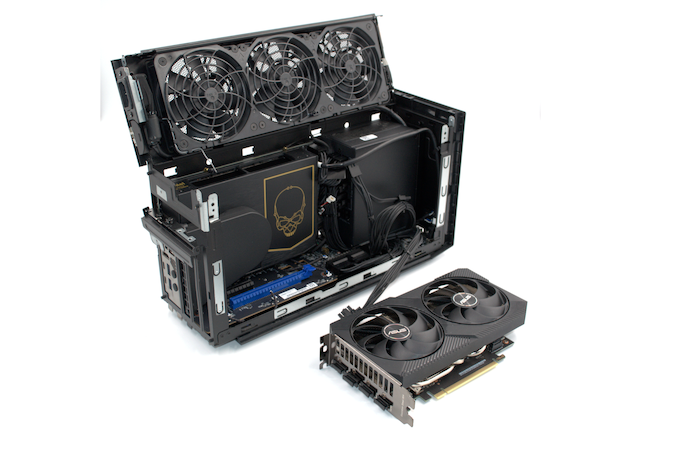
Regardless of the plastic framing within the entrance panel, the metal-based building in different areas offers the chassis a premium look and durable really feel. The Beast Canyon NUC chassis additionally options customizable RGB underglow lighting, in addition to replaceable RGB entrance brand. The chassis has ample area inside for straightforward cable administration even within the presence of a discrete GPU. These are updates over the earlier technology NUC Excessive.
The chassis additionally has a couple of downsides. The entrance USB ports are recessed, and given their Sort-A nature, determining the right orientation to plug within the peripherals is a little bit of a hit and miss. Sure keyboard / mice receivers can find yourself being fully contained in the recess, making it difficult to take away them when the opposite USB slot can also be occupied. The position of the PSU AC receptacle on the highest finish of the chassis signifies that the heavy AC energy wire may doubtlessly create cable administration points. In each these features, the Ghost Canyon NUC chassis had a significantly better design.
Our evaluate pattern of the NUC11BTMi9 got here with the next parts pre-installed:
- 2x Kingston HyperX KHX3200C20S4/8G for 16GB of DRAM
- 1x Sabrent Rocket NVMe 4.0 500GB M.2 2280 SSD
- ASUS Twin GeForce RTX 3060 12GB GDDR6
The presence of a desktop-class CPU within the system signifies that the Beast Canyon NUC ought to simply have the ability to assist highly effective GPUs such because the dual-slot RTX 3080 variants (despite the fact that we examined solely with the RTX 3060). Within the subsequent part, we check out the complete specs of our evaluate pattern, adopted by an in depth platform evaluation together with some notes on our setup expertise.
Posting Komentar
Posting Komentar